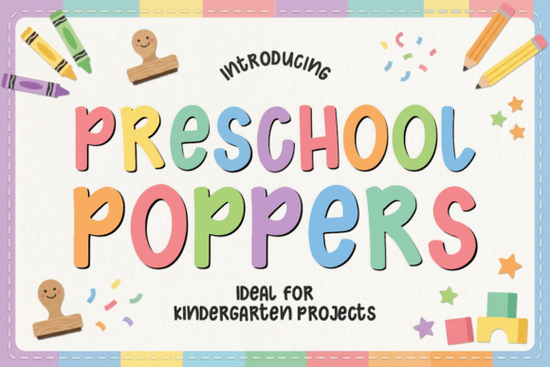
If you're designing for preschoolers think classroom posters, learning worksheets, name tags, or playful print-on-demand kids' apparel the Preschool Poppers Font is a thoughtful, well-crafted choice. It’s not just “cute” or “kiddie”; it’s intentionally designed to feel warm, inviting, and authentically childlike softly rounded, slightly uneven, and full of organic energy. That makes it especially useful when you want your typography to support early literacy without overwhelming young eyes.
What kind of designs does Preschool Poppers work best with?
This font shines in hands-on, tactile, and education-forward projects. Think letter-tracing sheets where the shape of each character mirrors how a 4- or 5-year-old might form it with crayon or marker. It also pairs beautifully with simple illustrations, sticker-style graphics, and clean layouts that prioritize readability over decoration. Because it’s a display font not meant for long paragraphs it’s ideal for headlines, titles, labels, and short callouts: “My Name Is…”, “Count to 10!”, or “Circle the Letter A”.
You’ll find it fits naturally alongside other friendly, expressive display fonts like Brother Font, which shares a similar handmade charm but leans slightly more structured. For contrast, try pairing it with something bolder and more graphic, like Urban Crack Font great for creating visual hierarchy on bulletin boards or activity cards.
How does it compare to other playful script and display fonts?
Unlike many script fonts that mimic formal cursive or calligraphy, Preschool Poppers avoids loops, sharp angles, and tight connections. Its letters sit comfortably on the baseline, with generous spacing and open counters (the enclosed spaces inside letters like ‘a’, ‘e’, or ‘o’) key features that help emerging readers distinguish shapes quickly. It’s less about elegance and more about accessibility and joy.
For example, Gardenia Font offers graceful, flowing script energy lovely for invitations or gentle branding but wouldn’t suit a phonics worksheet the way Preschool Poppers does. Similarly, Haydn Font brings strong personality and rhythm, but its tighter spacing and higher contrast make it better for older-kid themes or modern nursery decor than foundational learning tools.
And if you’re drawn to quirky, offbeat styles, Weird Vault Font offers bold, unexpected shapes but it’s more at home on novelty t-shirts or comic-style banners than in an inclusive preschool curriculum.
Who’s using this font and why does it matter?
We’ve seen teachers download it for editable Google Slides lessons, small business owners use it on vinyl-cut wall decals for daycare centers, and crafters layer it into Cricut projects for personalized backpack tags or growth charts. What ties those uses together isn’t just aesthetics it’s intentionality. The font supports developmental goals: building letter recognition, encouraging fine motor practice, and reinforcing a positive emotional connection to learning.
That’s why it’s worth checking licensing terms before use especially if you plan to sell physical products (like printed flashcards or embroidered onesies) or digital downloads (like editable PDFs). Creative Fabrica’s standard license covers both personal and commercial use, including POD platforms, as long as you’re not reselling the font file itself.
A few practical tips before you start designing
- Use it at larger sizes: It reads best from 36pt up smaller sizes can blur the friendly details.
- Pair it with a neutral sans-serif (like Montserrat or Open Sans) for supporting text this keeps focus on the learning content, not the decoration.
- Avoid stretching or skewing the font: Its charm comes from natural proportions distorting it weakens legibility and warmth.
- Test print samples: Especially if you’re cutting vinyl or printing on textured paper some subtle curves may need slight adjustment depending on your machine or printer.
If you're building a set of themed resources say, a full alphabet pack or seasonal learning bundle consider mixing Preschool Poppers with one complementary display font (like Brother Font for consistency) and a clean, highly legible body font for instructions or teacher notes. That kind of thoughtful pairing helps your work stand out not just visually, but functionally.
Next step: Download the font, open it in your design app, and try typing a simple phrase like “Let’s Learn!” or “ABC Time”. Then print it out and hold it next to a child’s actual handwriting. Does it feel like a friendly companion not a replacement, but a joyful extension of their own creative voice? If yes, you’ve found the right fit.
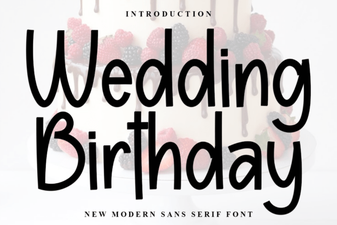 Elegant Wedding & Birthday Font Collection
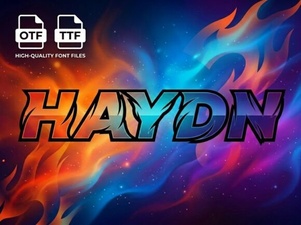 Haydn Font: Elegant & Versatile Design Inspiration
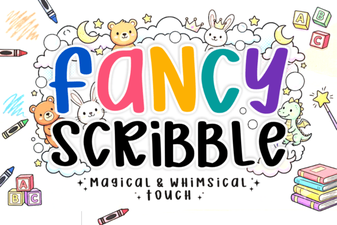 Fancy Scribble Font: Creative Design Ideas
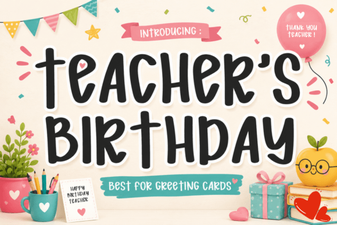 Playful Teacher’s Birthday Font Collection
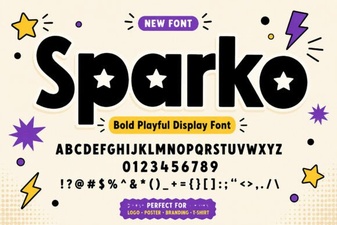 Sparko Font: Creative Design & Versatile Typography
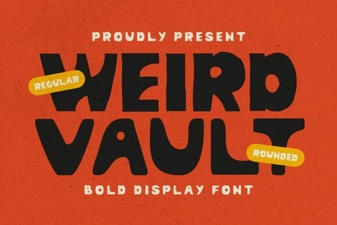 Weird Vault Font: Creative Design Inspiration